Why Your Success Keeps Triggering Self-Doubt (And What Actually Fixes It)New Blog Post
I learned something unexpected when I started working with executives who'd already achieved what most people dream about.
The higher they climbed, the louder the voice got.
You know the one. The voice that whispers you got lucky. That someone's going to figure out you don't belong here. That the next presentation, the next quarter, the next board meeting will be the one where everyone sees through you.
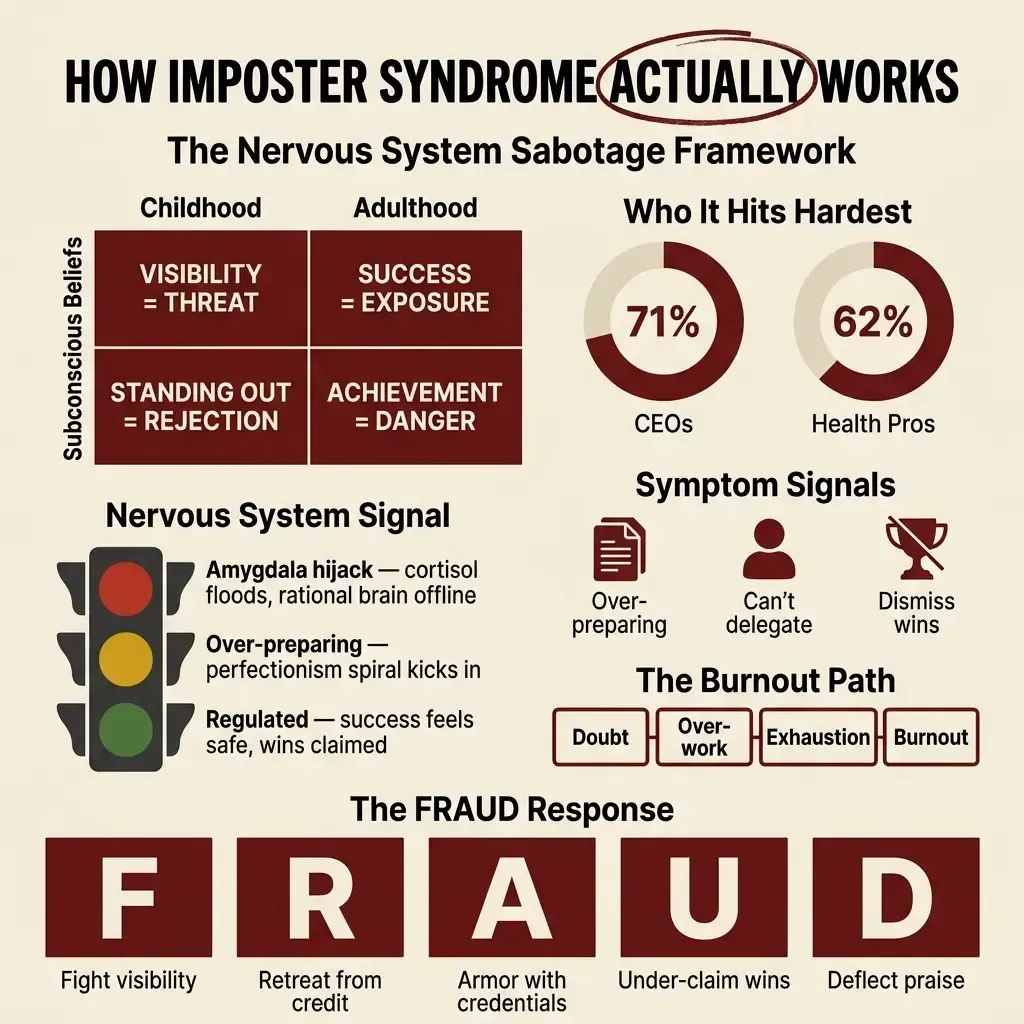
71% of US CEOsexperience imposter syndrome in their role. When I first saw that number, it confirmed what I'd been seeing in my practice. Success doesn't eliminate self-doubt. In many cases, it amplifies it.
Because now the stakes feel higher. Now there's more to lose. Now the gap between how others see you and how you see yourself gets wider.
The Pattern Your Brain Learned Before You Had Words
Here's what I've noticed after years of working with people experiencing this - imposter syndrome isn't a confidence problem.
It's a nervous system problem that lives in your body, not your resume.
Your subconscious mind learned early that certain levels of success, visibility, or achievement felt unsafe. Maybe you grew up in a family where being "too much" meant losing connection. Maybe you watched a parent get criticized for standing out. Maybe you learned that staying small kept you safe. Those patterns got wired in before you could think about them. They became part of your operating system. And here's what makes this tricky - your subconscious can't tell the difference between a physical threat and a social one. When you're about to step into a bigger role or claim a win publicly, your nervous system activates the same alarm it would if you were facing actual danger.
That's whyyour amygdalafloods your body with cortisol when you're preparing for that presentation. Your rational brain goes offline. The doubt takes over.
And each time you reinforce that doubt with negative self-talk, you strengthen the neural pathway. You're literally training your brain to diminish the reward signals after success.
Why Credentials Don't Fix This
I see people collect degrees, certifications, and achievements like they're building armor against the doubt.
It doesn't work.
A recent study found that62% of health service professionalsexperience imposter syndrome. These are people who've completed medical school, residencies, board certifications. Years of rigorous training. Extensive credentialing.
Nearly two-thirds still doubt their competence.
Because the problem isn't what you know. It's what your subconscious believes about safety.
If your nervous system learned that success equals exposure, and exposure equals danger, then no amount of external validation will override that program. You're running code that was written when you were five years old.
The Burnout Connection Nobody Talks About
Here's where it gets worse.
When you're constantly trying to prove yourself, constantly over-preparing to avoid being "found out," your body pays the price.
Research shows that seven in 10 knowledge workers experienced burnout or imposter syndrome in the last year. But here's what caught my attention - 42% experienced both.
I experienced this myself. My burnout didn't come from working too hard. It came from the internal war between what I was achieving and what I believed I deserved. That gap creates friction. And friction creates exhaustion.
The over-preparation. The perfectionism. The inability to delegate because "nobody else will do it right." These aren't work ethic. They're survival strategies your nervous system developed to keep you safe.
And they're costing you more than you realize.
What Actually Changes This
I'm going to be direct about this - you can't think your way out of a nervous system problem.
Affirmations won't rewire childhood programming. Positive thinking won't override a subconscious belief that success is dangerous.
What works is going to the level where the pattern was created.
Your subconscious mind doesn't speak the language of logic. It speaks the language of sensation, emotion, and imagery. That's why hypnosis and somatic work create shifts that years of traditional coaching can't touch.
When I work with someone experiencing imposter syndrome, I'm not trying to convince them they're competent. I'm locating the moment their nervous system decided that visibility equals threat. Then we reprogram that response.
Because your nervous system can learn new responses. It can learn that success is safe. That being seen doesn't mean being abandoned. That claiming your wins doesn't make you a target.
But it has to happen at the subconscious level, where the original program is running.
The Real Cost of Waiting
Research shows that people with high imposter syndrome scores delay career advancement by 18 to 24 months compared to those without it.
But the real cost isn't just time.
It's the opportunities you don't pursue. The ideas you don't share. The leadership roles you turn down because you're convinced someone else is more qualified.
It's building a successful career while feeling like a fraud the entire time.
I've watched brilliant people shrink themselves for years, waiting for the day they finally feel "ready." That day doesn't come through more achievement. It comes through rewiring the belief system that's running underneath.
Where This Leaves You
If you're reading this and recognizing yourself, I need you to feel something for a moment.
Feel the weight of showing up every day to a role you earned, while that voice whispers you didn't. Feel the exhaustion of over-preparing for every meeting because you can't afford to slip. Feel what it's like to celebrate a win publicly while privately wondering when they'll realize you're not who they think you are.
That heaviness you're carrying? It's not who you are. It's programming.
Old code that's been running so long you forgot it wasn't always there.
You've spent years building a career while fighting yourself. Over-working to compensate for feelings of inadequacy that have nothing to do with your actual competence. Saying no to opportunities because the doubt screams louder than the invitation. Watching others step into roles you're more qualified for because they don't have this weight.
How much longer are you willing to let a childhood survival strategy run your professional life?
I send weekly insights on reprogramming the subconscious patterns that keep high performers stuck - the beliefs about safety, worthiness, and visibility that were wired in before you had a choice.Connect with me on LinkedIn where I share what's working in real time.
The same patterns that create imposter syndrome show up in your relationships too. If you've ever felt like you have to shrink yourself to keep someone close, my book explores how those early programs affect the way you love.Get your copy here.