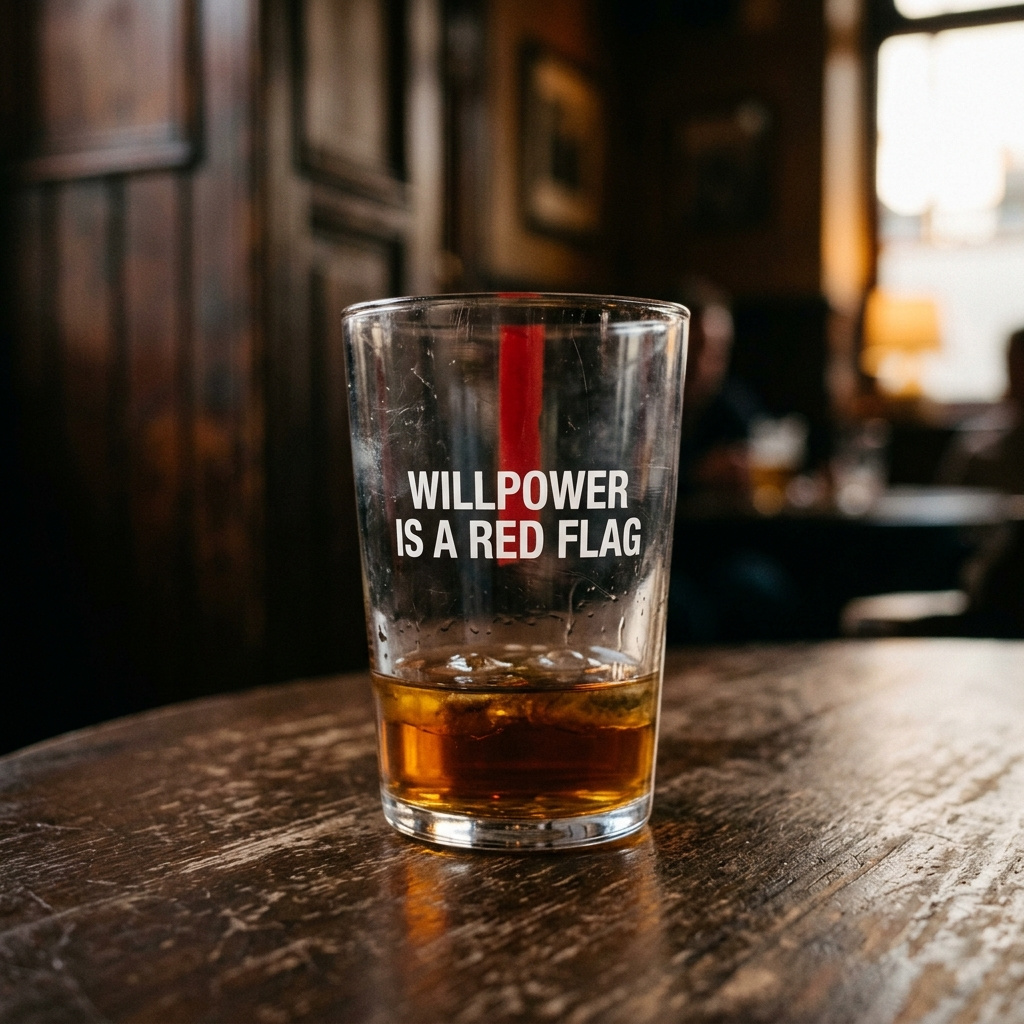
The Glass of Water: Why Needing Willpower Is a Signal, Not a Strength
I often ask my clients a strange question. When you're thirsty, do you need willpower to take a glass and make a sip? You feel thirsty, you drink. That's it. There's no forcing, no motivational speech, no discipline hack.
You just do it.
And this small observation carries something I've spent years learning the hard way. When an action is truly aligned with what you want and who you are, willpower becomes unnecessary. The moment you need to force yourself, something underneath is off.
Willpower Is Additional Stress
To me, willpower is additional stress. It's the energy you burn pushing yourself through a gap between what you say you want and what your deeper mind actually believes.
I once spoke with someone who wanted to change something in their life. I asked a simple question: once you change it, what will this be good for? They had no answer. And without that big why, they were left with pure force.
Research supports this experience. Studies on motivation found that intrinsic motivation protects against burnout, while purely external drivers increase it. Force from the outside exhausts you. Alignment from the inside carries you.
Understanding Doesn't Equal Doing
I work with executives who know exactly what they should do. They know they need to delegate. They know they need to communicate differently. When the moment comes, they freeze.
One client came to me after a heavy argument with her son. She watched herself put pressure on him, saw it going in the wrong direction, and still couldn't stop. This is a woman who reads psychology books and understands a lot.
Understanding doesn't equal doing.
What we found underneath was a childhood pattern. Be a good girl, comply, obey. That strategy kept her safe as a child. Decades later, it was running her most important relationships. Willpower had nothing to do with any of it.
The Program Underneath the Struggle
Every adult carries survival programs from childhood. Those programs run quietly, and they run fast. Your conscious mind processes roughly 40 bits of information per second while your subconscious handles about 20 million bits. When a conscious goal collides with a subconscious belief, the belief wins.
💡 Self-sabotage is a safety strategy. Your brain prefers what's familiar, even when the familiar quietly hurts you.
So the executive who "lacks discipline" around delegation usually carries a program that says control equals safety. The high achiever who keeps overworking usually carries one that says worth must be earned daily. More willpower on top of that program just burns fuel.
What I Found in My Own Story
I know this from the inside. After my own burnout, I traced my patterns back to my own childhood programming. I found the same good girl pattern I now see in so many of my clients. Meet expectations, stay polite, say yes, avoid conflict.
The pattern looks similar across people, and the stories that installed it are unique to each person. That's why generic tools fall short. The root has to be found and closed at its own address.
In my work, I use regression and clinical hypnosis to reach that root. We extract the positive learning from the old story, close what was negative, and project the changed program into the future. Afterward, clients notice situations that made them anxious simply stop triggering them. One internal shift ripples into leadership, family, health, everything.
What to Look for Instead of More Discipline
If you keep needing willpower for the same thing, month after month, I'd gently invite you to stop asking how to try harder. Ask instead what belief makes this action feel unsafe.
A few places to look:
Your why. If you can't name what the change is good for, the force you're using has no destination.
Your comfort. Notice where you fall back into the familiar even when you know a better way.
Your small wins. If you can't see small changes, the big ones stay invisible too.
When something is aligned, it feels like drinking water when you're thirsty. You just do it, without announcing it, without negotiating with yourself.
That feeling of inner stability, of quiet standing power, is what I want you to take from this. Live your values instead of pushing against them.
So here's my question for you: where in your life are you still using willpower, and what do you think it's covering up?