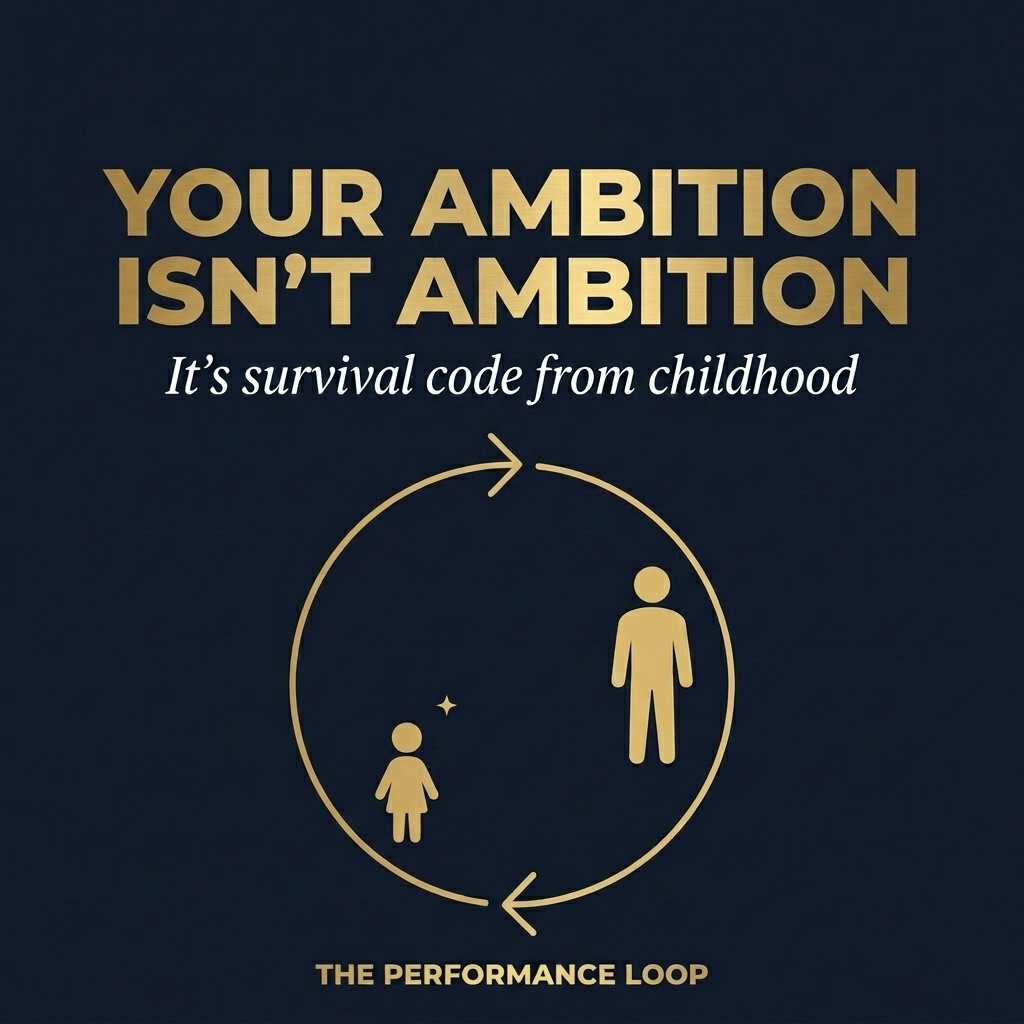
The Hidden Cost of High Achiever Trauma: Why Successful People Still Feel Empty
If you're still running—still achieving, still proving, still exhausted despite the success—you're not broken. You're running code that was installed decades ago.
Most high achievers don't think of themselves as traumatized. They think of themselves as resilient. Driven. Successful.
But here's what nobody talks about: that relentless drive often isn't ambition. It's survival.
What happens when a child becomes a product before they become a person? When they're praised for performance more than presence. For achievements more than authenticity. For what they do, not who they are.
At first, it looks like success. Then it becomes a cage.
The Performance Trap: When Children Learn Love Must Be Earned
The child performs. The child achieves. The child learns how to make adults happy.
But underneath the gold stars and proud smiles, something else is happening—something that will echo through decades of their life.
The child is learning that love, approval, and value must be earned. And that's where the subconscious programming begins.
Research in attachment theory demonstrates correlations between conditional parenting and higher rates of anxiety disorders, perfectionism-driven stress, imposter syndrome, and chronic self-doubt. This conditioning stresses the nervous system, raising cortisol levels and creating anxiety patterns that persist into adulthood.
The nervous system remains in a low-level activation state, always prepared for the withdrawal of acceptance. Even when the parent is long gone, the program keeps running.
Because children grow up. But the code often stays.
The Adult Disguise: When Ambition Masks Unhealed Wounds
Years later, that same child may become incredibly successful.
They build careers. Earn money. Gain recognition. Become industry leaders.
And yet still feel like they're chasing something just beyond reach.
The next achievement. The next compliment. The next proof that they're enough.
Burnout in high achievers often hides behind productivity, professionalism, and perfectionism—showing up as success that no longer feels fulfilling, a deep weariness masked by productivity, or emotional flatness that creeps in despite external wins.
In a recent study, 60% of executives who reported struggling with mental health issues turned to potentially unhealthy coping mechanisms like alcohol or substances to manage the pressure. Data from the National Institute on Drug Abuse indicates that individuals in high-pressure professions face a greater risk of developing substance use disorders than the general population.
The saddest part? This childhood conditioning follows us into adulthood disguised as ambition.
The promotion we chase. The achievement we need. The perfectionism we can't shake. The inability to rest. The constant feeling that we still have something to prove.
High achievers burn out because perfectionism creates unrealistic standards, achievement addiction, and the belief that rest must be earned.
The Neuroscience of Conditional Love: Understanding the Subconscious Code
Here's what most people don't understand about childhood conditioning: it doesn't just create beliefs. It creates neural pathways. Automatic programs. A subconscious operating system that runs in the background of every decision, relationship, and achievement.
According to attachment theory, when caregivers are unresponsive or emotionally absent during critical moments, children internalize beliefs about their worthiness of love—beliefs that become a working model for adult relationships.
The sense of belonging becomes perpetually provisional, requiring continuous re-earning through visible contribution, compliance, or achievement. You're not relaxing at the finish line. You're sprinting toward a goal post that keeps moving.
This isn't metaphorical. High achievers often develop dampened dopamine receptors, requiring bigger hits of stimulation to feel anything—which makes both substances and achievement dangerously effective at providing temporary relief.
The body keeps the score. And the nervous system never forgets what it learned about love.
A Case Study in Stolen Childhood: The Michael Jackson Story
When I look at Michael Jackson, I don't just see a music icon or a celebrity.
I see a child who was introduced to performance before he had a chance to discover who he was without it. A child who learned very early that being exceptional wasn't optional—it was survival.
Jackson was so afraid of being in the presence of his physically abusive father that it made him vomit, he told Oprah Winfrey in a 1993 interview. From a young age, Jackson and his siblings were allegedly physically and emotionally abused through incessant rehearsals, whippings, and derogatory name-calling.
By the age of 11, Jackson was the lead singer of the world's first boy band and an international sensation. But the success didn't bring happiness; instead, loneliness and fear seemed to consume him—his childhood years were "very, very sad."
The price paid for his successful career translated to never having the chance to fulfill the childhood that the average child encountered—in exchange for greatness, Jackson had to abandon the school yard and playground sets.
And perhaps that's why his story still resonates with so many people.
Because most of us were never asked: "Who are you?"
We were asked: "What can you do?"
And those are two fundamentally different questions that create two entirely different human beings.
The Cost Nobody Talks About
Adults who experienced conditional love may relentlessly strive for exceptional achievements, working excessively hard to uphold external expectations, hoping that success will finally reward them with love and acceptance—consequently struggling with chronic stress, burnout, and an inability to recognize their achievements.
Maybe that's why so many successful people are still exhausted.
Not because they're chasing success. But because they're still chasing the love, approval, or acceptance they learned to earn as children.
Some people in late burnout describe feeling numb—not sad exactly, but flat, disconnected, like the color has drained out. Burnout often manifests somatically: persistent fatigue that sleep doesn't fix, frequent illness, back pain, headaches, GI problems—your body sending messages your mind has been ignoring.
Most high-achieving professionals do not recognize they are burned out until it is too late—burnout rarely looks like collapse; it is quieter, more deceptive.
Modern culture sometimes inadvertently reinforces these patterns through metrics-obsessed systems, achievement-focused environments, and social media validation loops—meaning many adults carry multiple layers of conditional worth programming from both childhood attachment patterns and ongoing environmental messaging.
Breaking the Code: From Recognition to Reprogramming
Here's the truth that changes everything:
You can't think your way out of subconscious programming.
You can read every self-help book. Attend every seminar. Set better boundaries. Practice more self-care.
And still feel like you're running on a treadmill you can't step off.
Because the problem isn't in your conscious mind. It's in the code that was written before you had language to question it.
The belief that love must be earned. That rest must be justified. That your value is tied to your output. That stopping means failing. That you are what you achieve.
When love or attention were conditional, adults become highly self-critical and derive their value solely from productivity or achievement. This isn't a character flaw. It's an adaptation. A survival mechanism from a child who learned how to stay safe, stay loved, stay visible.
But what kept you safe then is burning you out now.
Real transformation doesn't come from working harder or achieving more. It comes from going beneath the surface—locating the subconscious program, understanding where it came from, and systematically rewriting it.
Not through willpower. Through reprogramming.
The Question That Changes Everything
So here's a question worth sitting with—not answering quickly, but letting it land somewhere deeper than your usual defenses:
Were you loved for who you were? Or for what you could do?
If you felt that question in your body before your mind could answer it, you already know.
And if you're still running—still achieving, still proving, still exhausted despite the success—you're not broken.
You're running code that was installed decades ago. Code that once protected you. Code that now traps you.
The good news? Code can be rewritten.
But first, you have to stop long enough to see it's running.
Ready to Rewrite the Program?
If you recognized yourself in this article—if you felt the weight of performance-based love in your chest, if you've been successful on paper but exhausted underneath it—you're not alone.
And more importantly, you're not stuck.
I work with high-achieving executives and professionals who've hit their internal ceiling. People who've tried everything else and are ready to go deeper. People who understand that sustainable high performance doesn't come from pushing harder—it comes from reprogramming the subconscious patterns that keep them trapped in the achievement loop.
This isn't coaching that stays on the surface. This is clinical hypnosis and subconscious reprogramming that locates the root code and rewrites it. Permanently.
If you're done running and ready to become unshakable from the inside out, let's talk.
Book a discovery call and let's see if this work is right for you. Because the next level of your performance isn't about doing more. It's about becoming different.
→ Schedule your breakthrough session here