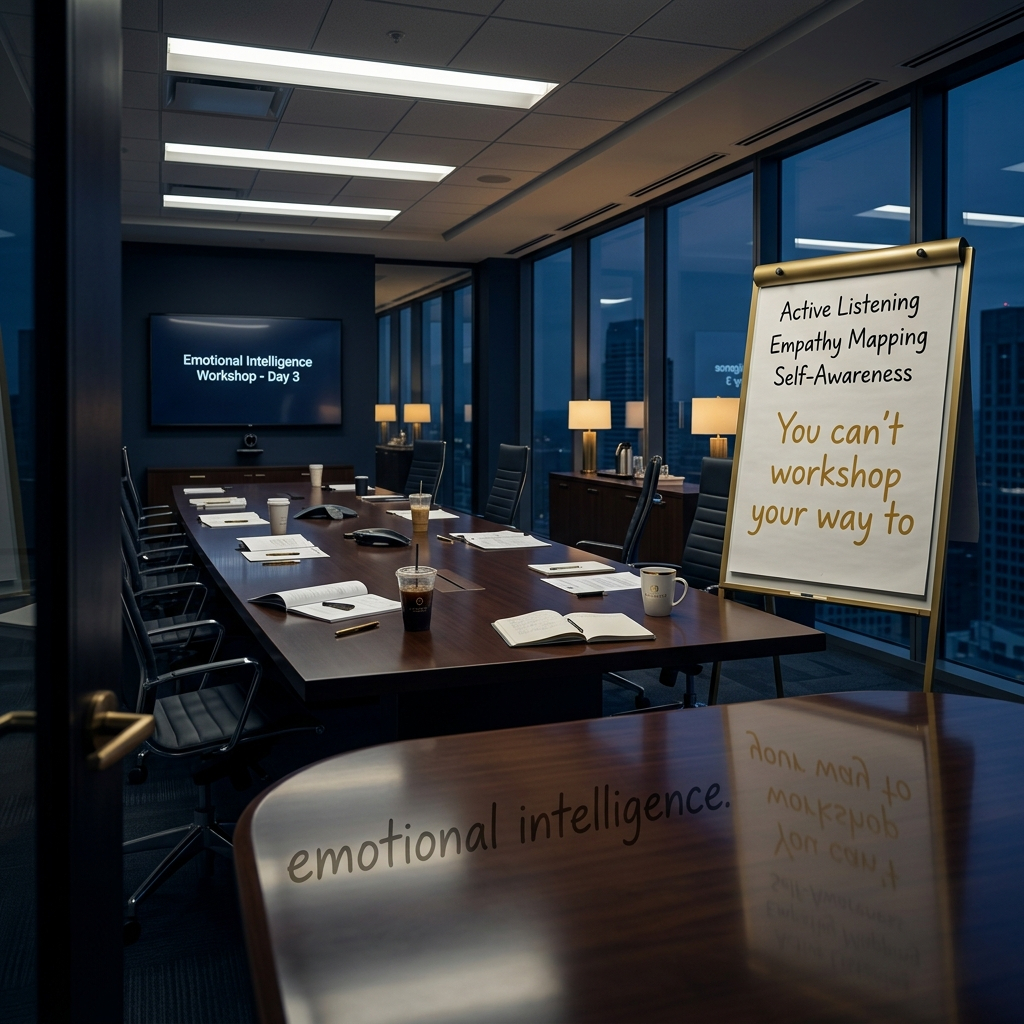
The Leadership Skill AI Can't Replace: Why Emotional Intelligence Must Be Reprogrammed, Not Taught
You know that moment when you snap at someone who didn't deserve it, and the shame hits you before the words even finish leaving your mouth?
When exhaustion isn't tiredness anymore, but something heavier burrowed into your bones, and the thought of stopping feels like admitting defeat?
When you look at your team and realize you're holding their stress in your body while drowning in your own, and nobody sees how much weight you're carrying?
I've been there. I know what it feels like when your nervous system is screaming but you keep smiling through the meeting.
Dr. Julie Fuller, CHRO of Zoetis, recently said something that stopped me mid-scroll.
She believes emotional intelligence, teamwork, and human connection will become the most critical leadership skills as AI reshapes the workplace. While organizations race to build technical fluency and AI readiness, the human capabilities remain irreplaceable.
I agree with her completely.
But here's what hit me hardest, and what most people miss:
Emotional intelligence can't be taught the way we've been trying to teach it.
You won't workshop your way into feeling safe enough to be vulnerable with your team. You won't read a book and suddenly stop the pit forming in your stomach when conflict walks through the door. You won't attend a seminar and walk out magically knowing how to hold space for someone else's pain when you haven't learned to hold your own. When your hands still shake and your throat still closes and your mind still goes blank.
Because emotional intelligence doesn't live in your conscious mind.
The $8.8 Trillion Problem Hiding in Plain Sight
Let me show you something that might explain why you feel the way you do.
Global emotional intelligence scores have dropped 3.5% since 2020. Well-being fell 3.92%. Optimism dropped 4.87%.
Those aren't numbers. You're checking your phone at 11 PM and feeling your chest tighten like something's wrapped around your ribs. The Sunday evening dread became so normal you stopped mentioning it to anyone. The distance you feel between who you are at work and who you are everywhere else, and the exhausting performance of pretending they're the same person.
This isn't a training gap. This is what researchers are calling an "Emotional Recession". The global economy loses $8.8 trillion annually in employee engagement alone.
But forget the economy for a second. What's it costing you?
Your sleep. Your relationships. The version of yourself you barely recognize anymore.
Trust has collapsed to historic lows. The 2026 Edelman Trust Barometer shows 70% of people worldwide now have an "insular mindset", unwilling or hesitant to trust someone with different values, problem-solving approaches, or cultural backgrounds.
Only 32% believe the next generation will be better off.
Read that again. We've stopped believing things can get better.
Teams that strongly trust their manager are four times more likely to be engaged and one-third as likely to burn out. But manager engagement itself dropped 27% recently, directly linked to a 21% fall in overall workforce engagement.
The story these numbers tell is clear: we're losing our capacity to connect, adapt, and lead through complexity.
And no amount of AI tools will fix that.
Why Traditional Leadership Training Operates on Just 5% of What Actually Drives Results
Neuroscience shows only 5% of cognitive function is conscious.
The remaining 95% operates unconsciously.
Most leadership development focuses on conscious skills. Communication techniques, decision-making frameworks, conflict resolution strategies. But successful leaders are running on unconscious patterns. These patterns stay completely invisible to traditional training.
We've been trying to solve a 95% problem with a 5% solution.
I learned this the hard way during my own burnout.
I had all the conscious tools. I knew what I should do. I understood the frameworks. I could tell you what emotionally intelligent leadership looked like.
But my body kept responding the same way. My nervous system kept triggering the same patterns. Heart racing during simple conversations, jaw clenched through every decision, that familiar tightness in my chest from holding more than I could carry. My subconscious kept running the same code. The one installed decades ago, the one saying rest equals weakness, boundaries equal failure, feeling anything too deeply was dangerous.
The conscious mind cannot solve subconscious problems.
When executives come to me after trying therapy, coaching, and willpower and still hitting the same wall, this is why. They've been working on the wrong level.
I help high-performing leaders reprogram their subconscious architecture so they lead from stability instead of survival. You learn more about my work on LinkedIn, where I share what I'm learning about subconscious reprogramming, resilience, and the kind of transformation that lasts.
The Hidden Neurological Cost of "Empathetic Leadership"
Here's something most leadership experts won't tell you, something I wish someone had told me years ago:
The shift toward more emotionally intelligent, empathetic leadership has created an unexpected burden for executives who weren't trained in emotional regulation.
When leaders are in constant empathy mode, they're sharing the neurobiological load of their team's stress.
The neuroscience of empathy shows truly understanding and responding to others' emotions activates leaders' own emotional centers. Without proper boundaries and recovery, this emotional labor becomes depleting.
Research on 840 managers found emotional intelligence augments the negative association between burnout and motivation when not properly integrated with autonomous motivation. This reveals a "dark side". Emotional intelligence training alone, without addressing underlying subconscious programming, intensifies burnout in some contexts.
I see this pattern constantly. High-performing executives who've been told to be more empathetic, more present, more emotionally available. But nobody taught them how to regulate their own nervous system first.
Nobody showed them how to create internal stability before taking on everyone else's emotional weight.
You're in back-to-back meetings, holding space for your team's anxiety about restructuring. You're nodding, listening, being present, like you're supposed to. Then you get home and realize you've been clenching your jaw for six hours straight. Your shoulders are up near your ears. You have a headache behind your eyes for weeks. Your partner asks how your day was and you barely form words because you've used them all up.
You're trying to pour from an empty cup, and your subconscious is screaming for relief.
This is why emotional intelligence in leadership doesn't separate from emotional intelligence in relationships. With yourself first, then with everyone around you. The same patterns showing up in the boardroom show up at your dinner table. The same inability to set boundaries at work bleeds into every other connection in your life.
What Happens When Chronic Leadership Stress Rewires the Brain
When executives are in constant high-stakes decision-making mode, the brain's executive functioning centers, the prefrontal cortex, become overloaded and fatigued.
This leads to decision fatigue and cognitive load overwhelm.
At the same time, the brain's threat detection system, the amygdala, becomes hypervigilant, triggering the same neurobiological response to every "urgent" email our ancestors had to physical danger.
Leaders with high emotional intelligence show greater resting-state connectivity between the medial prefrontal cortex and posterior superior temporal sulcus, a network associated with mentalizing. Their teams report lower burnout rates and higher psychological safety scores over a 12-month period.
Emotionally intelligent leaders show a shift from reactive amygdala-driven response patterns to anticipatory lateral prefrontal regulatory engagement.
They're preparing neurologically for social demands before they arise rather than managing the aftermath.
You can't learn that in a workshop. That's a subconscious pattern that has to be reprogrammed.
Why High-Performing Teams Pair AI with Human Skills
Deloitte's research on high-performing teams reveals something interesting: while these teams are more likely to use AI tools (78% vs. 54%), their strongest results come from how they work with each other.
The World Economic Forum's 2025 Future of Jobs report predicts rising demand for human-centered skills like resilience, flexibility, and leadership as AI adoption accelerates. More than 40% of workers' core skills will be disrupted by 2027.
What remains, and what now differentiates leaders, are enduring human skills like judgment, communication, and the ability to move people toward better outcomes when the path is ambiguous.
Organizations embedding emotional intelligence in leadership programs report 20-30% better results across engagement levels, retention, and output quality.
The Subconscious Runs the Show
Research from cognitive neuroscience shows that up to 95% of brain activity occurs at the subconscious level, shaping thoughts, emotions, and behaviors without conscious awareness.
The subconscious mind controls your behavior. Attracts patterns. Seeks familiarity. Cannot process negation.
Traditional approaches focus on managing emotions. The real breakthrough lies in reprogramming subconscious patterns.
I use clinical hypnosis because leaders access the subconscious directly in a deeply relaxed state to rewire beliefs quickly and effectively. This is powerful for persistent or high-stakes patterns conscious effort alone won't shift.
When someone comes to me after years of trying to "fix" their leadership style through conscious effort, I don't give them more tools for their conscious mind. I help them identify the subconscious code running the loop. The childhood programming, the limiting beliefs, the nervous system patterns installed before they even knew they were there.
Then we rewrite it.
One internal shift creates cascading external change across every area of life. I've watched executives transform their entire leadership presence in weeks after spending years trying to change through willpower alone.
The difference is working at the right level.
What This Means for Leaders in the AI Era
AI will handle the technical work. Process data, generate insights, automate decisions.
But AI won't build trust. Won't navigate ambiguity. Won't help people adapt to change. Won't create psychological safety. Won't regulate a nervous system or reprogram a subconscious pattern.
The leaders who thrive in the next decade won't be the ones with the most AI tools. They'll be the ones who've done the internal work to become unshakable from the inside.
They'll be the ones who understand emotional intelligence isn't a skill you learn. It's a subconscious architecture you build.
They'll be the ones who stopped trying to manage their emotions and started reprogramming the patterns creating them.
True leadership comes from stability, not survival. From an internal foundation external chaos won't disturb.
You won't teach that foundation. You build it at the subconscious level.
If you've been trying to develop emotional intelligence through conscious effort alone, reading books, attending workshops, practicing techniques, and you're still hitting the same walls, you know why.
Wrong level.
Ready to Rewrite Your Operating System?
I know this problem because I lived it.
I was the high-performer who hit a wall so hard it nearly broke me. Burnout forced me to see everything I'd been doing to lead, to succeed, to hold it all together was built on subconscious programming I didn't even know was running.
When I rebuilt myself from that collapse, I had to go deeper than conscious strategies. I had to reprogram the architecture underneath. The beliefs installed before I had language for them, the patterns inherited from childhood, the code running automatically beneath every decision I made.
Then everything shifted. Not about leadership alone, but about how transformation works at the deepest level.
What I do now is work one-on-one with executives and high-performers who've hit an internal ceiling. Leaders who are done with surface-level fixes and ready to work at the level where real change happens. The subconscious.
Through clinical hypnosis and subconscious reprogramming, I help them identify the hidden patterns running their leadership, relationships, and resilience. The ones keeping them stuck no matter how hard they try consciously to change.
Here's what I discovered through my own collapse and rebuilding: the same subconscious patterns sabotaging your leadership also sabotage your relationships. The inability to set boundaries at work? Same pattern showing up at home. The overgiving leading to burnout in your role? Same architecture creating toxic dynamics in your personal life.
I wrote about this in my bestselling book, Loving Without Losing Yourself. While the book focuses on toxic relationships, the core principle is the same one driving my work with executives: you won't transform what you're experiencing on the outside until you reprogram what's running on the inside.
The leaders who do this work don't change how they lead alone. They change how they relate to everyone in their life. Because it's all connected. The subconscious patterns are the same.
If you're ready to explore working together, connect with me on LinkedIn where I share insights about subconscious reprogramming, leadership transformation, and the kind of change that lasts.
And if the connection between leadership patterns and relationship patterns resonates with you, you explore Loving Without Losing Yourself. The framework applies whether you're in a boardroom or a relationship draining the life out of you.
What I'm curious about: if you could reprogram one subconscious pattern running your leadership, one belief, one fear, one automatic response, what would it be?