When Passion Becomes Obsession: What Bryan Johnson's Stomach Taught Me About the Limits of Technology
There's something quietly devastating about watching someone pour everything into not dying — and still having their body turn against them.
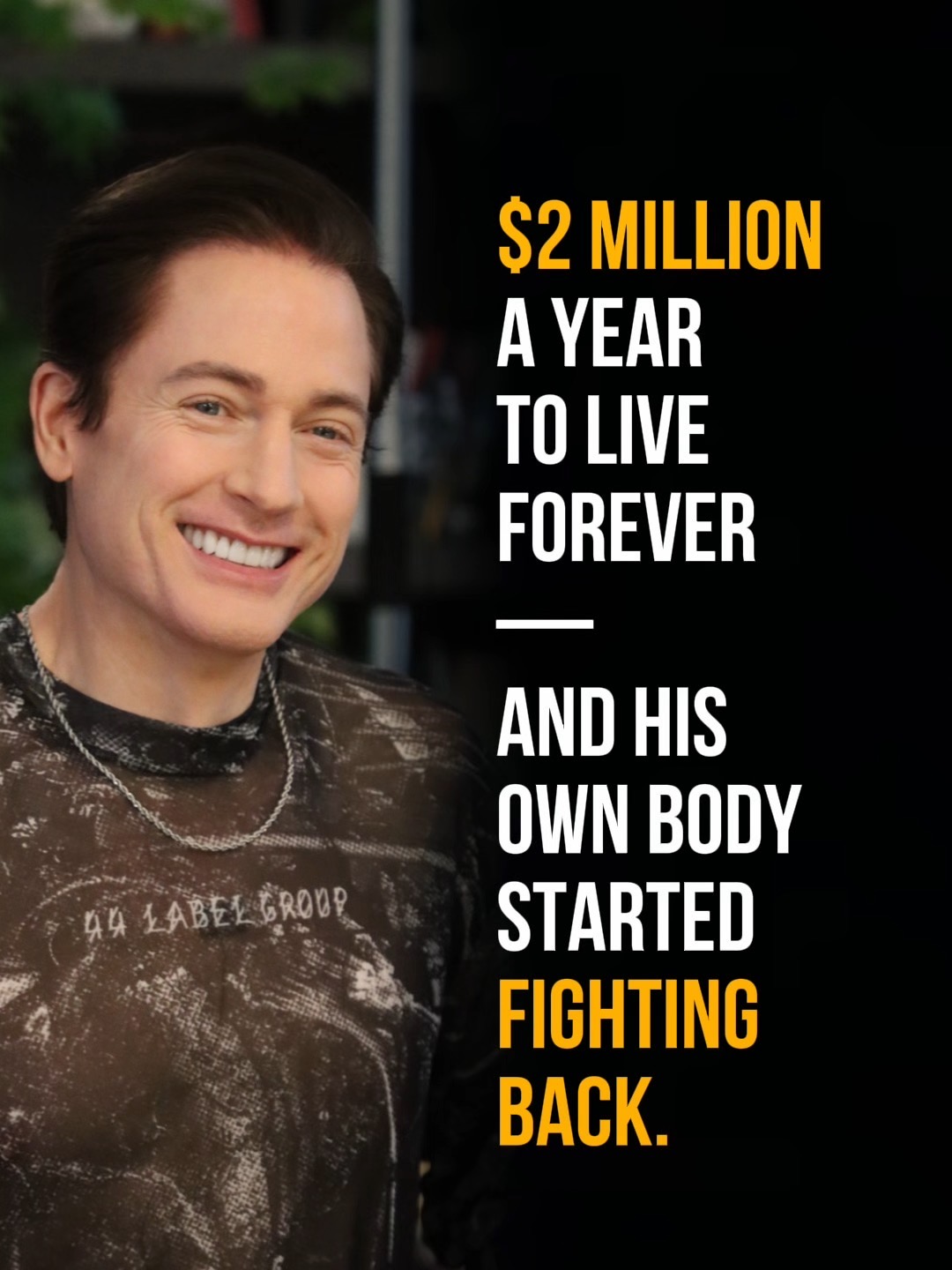
Bryan Johnson spends around two million dollars a year on his own biology. His philosophy is three words: don't die. He has a team of roughly thirty doctors. He tracks, measures, and optimizes nearly every biological input imaginable — sleep, nutrition, blood, hormones, light exposure. He's built an entire identity around the idea that if you control enough variables, death becomes negotiable.
And then, just recently, he announced he has autoimmune gastritis — a chronic condition in which his immune system attacks the lining of his own stomach. The disease had been quietly developing for years, hiding in plain sight even from the most measured human alive.
I sat with that for a while. And something came up that I want to share — because this case makes a picture I've been holding for a long time feel painfully, undeniably clear.
Two Million Dollars Can't Buy What Only You Can Give
I want to be careful here. I don't know Bryan Johnson personally. I can't diagnose him from a distance and I wouldn't try.
But I can share what I've observed — in my own body, and in the bodies of the executives I work with.
The pattern I keep seeing is this: the harder someone grips control, the more their inner world contracts. And the body, which is always listening, starts to reflect that contraction — sometimes quietly, sometimes loudly, sometimes in the very organs that carry the most symbolic weight.
💡 Here's the part that took me years to understand: healing needs the person, and technology can only assist.
You can measure every biomarker. You can optimize every input. And if your inner state is running a program of pressure, control, and fear, your body receives that signal every single hour of every single day.
Thirty doctors watching you daily is also a signal. Constant monitoring tells your nervous system that something is always potentially wrong. From my experience with clients, that level of vigilance creates its own quiet stress load. The body listens to that.
The Stomach Is Where Will Lives
This is where it gets interesting for me, because of where the condition showed up.
If you look into psychosomatic research and related fields, you'll find a growing body of evidence studying how emotional states influence immune function. A meta-analysis of over 300 studies confirmed a meaningful relationship between psychological stress and immune system parameters in humans. And retrospective research found that up to 80% of autoimmune patients reported unusual emotional stress before their disease onset — a figure that's hard to dismiss as coincidence.
The stomach region is the center of will, personal power, and identity. It's where drive lives. It's where passion lives.
Now hold that next to a philosophy called "don't die."
Notice what that phrase is built on. It's built on avoidance. The entire mission orients around what must be prevented rather than what pulls you forward. In my work with executives, I see a version of this often. Someone organizes their whole life around avoiding failure, avoiding loss, avoiding collapse. Their energy contracts. Their passion goes quiet. And their body starts reflecting that absence. Research suggests that chronic stress may dysregulate the immune system, shifting it toward autoimmune responses — which is a clinical way of saying the body starts fighting itself when it can't find a real enemy outside.
⚠️ I offer this as a lens, one I've found useful, and I invite you to test it against your own experience rather than take it as law.
When passion becomes absent, when life becomes pure management and measurement, the center of the body registers it first. An immune system turning against the stomach reads to me like a body in conflict with its own center. I find that image hard to ignore.
Your Body Can Heal Itself, With Your Participation
I believe deeply in the body's capacity for self regulation. I've watched it in my clients and I've lived it myself.
And that capacity comes with a condition. It asks for your participation.
Not more procedures. Participation looks quieter than that:
Honest inventory of your stress, including the stress your ambitions create
Attention to what you're avoiding, because avoidance is a full time job for your nervous system
Reconnection with genuine desire, the kind that pulls you toward life instead of away from death
Inner stability that stays intact when the data looks bad
Technology has its place. I'm grateful for medicine. I refer clients to clinical care when they need it, without hesitation.
What concerns me is the outsourcing. Handing your health entirely to external systems means handing away the one variable that carries the most weight, which is you. Your beliefs. Your subconscious programs. Your relationship with your own life force.
The most lasting shifts I've witnessed
ail come from working inside out. The external tools play a role. The internal reprogramming does the actual work.
A Question Worth Sitting With
I hope Bryan Johnson finds his way through this. I mean that sincerely. His experiment has taught the world something real, even if the lesson turns out different from the one he intended.
For you, I'd offer this gently. Health lives in the space where your inner world and your body meet. No budget replaces that meeting.
So here's what I'm sitting with, and I'd love to hear your take: if you stopped organizing your life around what you're trying to avoid, what would you actually be living for?
If that question stirred something, I'd love to explore it with you. I work with executives and high achievers who sense that the real ceiling isn't external — and are ready to look at what's actually running the show. Book a complimentary 30-minute call here, and let's find out together.